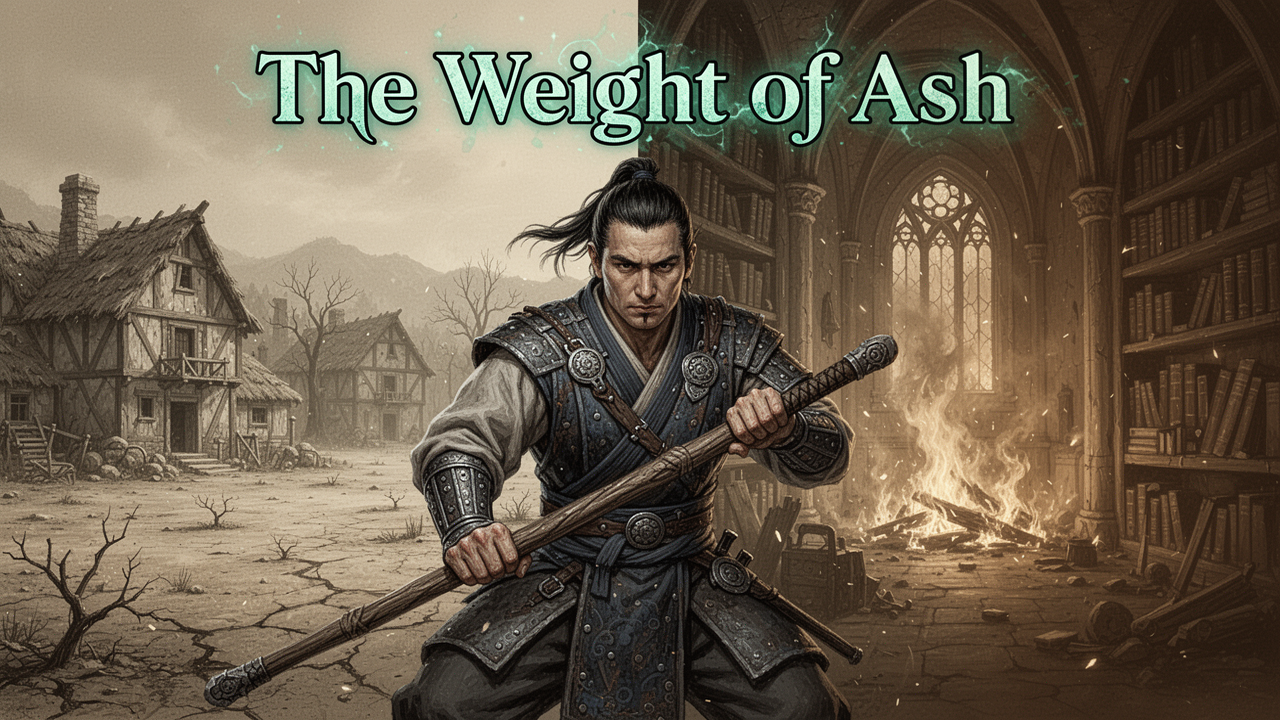
The Weight of Ash
Chapter 1: The Final Trial (The Peak of Pride)
The air at the peak of the Monastery of the Iron Mountain was not merely cold; it was thin, sharp, and possessed a crystalline clarity that seemed to punish the lungs of the unworthy. In the high, frozen courtyards, the only sound was the rhythmic snap of prayer flags against the biting wind, a sacred silence that Kenji had come to revere as the voice of the mountain itself.
Kenji stood at the center of the courtyard, his feet planted wide in the Iron Mountain Stance. His center of gravity was low, his heavy quarterstaff held across his body like a boundary line between the mortal world and the divine. He was performing the Trial of the Unmoving Stone, the final test of his decade-long training. For three days, he had not moved. For three days, he had been the mountain.
Beyond the heavy timber gates of the monastery, a different sound began to bleed into the silence. It was the sound of weeping and the desperate scratching of fingernails against wood. A band of mountain bandits, gray-faced from hunger and shivering in rags that offered no protection against the frost, had collapsed at the threshold. They did not come with blades drawn; they came as beggars, pleading for a handful of grain from the monastery’s winter stores.
Kenji did not flinch. To him, these were not men; they were distractions—the final “storm” intended to break his concentration. He believed that true discipline meant remaining an immovable object, regardless of the chaos swirling at his feet. He felt a flicker of disdain for their weakness, a quiet pride in the fact that he had trained his body to endure what they could not. He was, in his own mind, the perfect student.
The heavy internal bolts of the gate groaned. Elder Osu, his face a map of deep-set wrinkles and ancient wisdom, stepped into the courtyard.
“The mountain does not eat, Kenji, but it provides shelter to those who seek it,” Osu’s voice was a soft rumble, yet it carried over the wind. “Open the gates. Yield the grain to save them from the frost.”
Kenji’s eyes remained fixed on the horizon, his muscles locked in a rigid, stubborn interpretation of Iron Mountain’s strength. He believed this was the true trial—a test of his resolve to protect the sacred stores against the “mercy” of a master who might be testing his student’s protective instincts.
“Master,” Kenji replied, his voice as cold as the ice beneath his boots. “Discipline is the wall that protects the sacred. To yield is to break the mountain.”
“To be a mountain is to endure the weight of the world, not to crush those beneath it,” Osu countered, his disappointment a palpable shadow in the bright snow.
Ignoring the warning in his master’s tone, Kenji shifted his weight. It was the first time he had moved in seventy-two hours, but it was not to open the gates. He braced his quarterstaff, his posture becoming even more aggressive as he barred the way to the granary. He would not allow the “sacred” stores to be diminished by those he deemed unworthy.
He did not see the desperation in the bandits’ eyes as the gates finally swung open by Osu’s hand; he only saw intruders. As the first of the starving men stumbled forward, reaching for the warmth of the inner halls, Kenji lunged. He did not use the grace of the crane; he used the blunt, efficient violence of the mountain.
He did not know that this single act of rigid pride would be the spark that set his world—and the Jade Scroll of Wind Spirits—into a conflagration that would haunt him for a thousand acts to come.
Chapter 2: The Conflagration (The Shattered Wind)
The courtyard, once a sanctuary of crystalline silence, dissolved into a cacophony of panicked breaths and the dull thud of wood against bone. Kenji moved with a terrifying, mechanical grace, his Iron Mountain Stance providing a foundation that no starving beggar could hope to shake. He did not swing his quarterstaff with the wild abandonment of a brawler; every strike was a short, punishing thrust or a crushing parry designed to repel the “intruders” with brutal efficiency.
The bandits were not warriors. They were hollow-cheeked men driven by the primal madness of winter hunger, yet Kenji treated them as if they were a high-tier invasion force. A man lunged for a sack of grain near the library doors, and Kenji was there. With a sharp exhale, he planted his feet and drove the end of his staff into the man’s solar plexus—the Rooted Stone Defense in its most unforgiving form. The bandit folded like damp parchment, gasping for air that would not come.
In the chaos, a torch carried by one of the desperate men was kicked aside as they scrambled to avoid Kenji’s heavy strikes. It tumbled through the air, a small, spinning arc of orange flame, and landed among the dry, ancient tapestries hanging at the entrance of the monastery’s Great Library.
The fire did not catch slowly. Fed by the oxygen of the mountain winds and perhaps fueled by the ancient, magical energies stored within the scrolls, the flames roared to life with a sound that was not a crackle, but a high-pitched, supernatural scream.
“The library!” Elder Osu’s voice broke through the din, no longer a rumble but a sharp command of distress.
Kenji froze. The heat from the doorway was already intense, a shimmering wall of gold and red that made the surrounding snow hiss into steam. He realized, with a sudden, sickening drop in his stomach, that his “discipline” had created the very opening the fire needed. Ignoring the bandits, he sprinted into the smoke.
His eyes watered, his lungs burning as he reached the center of the archive. There, resting on a pedestal of dark stone, was the Jade Scroll of Wind Spirits. He reached for it, his hands outstretched to save the monastery’s greatest treasure, but the heat was no longer natural. It was a white-hot radiance that pushed back against his very soul.
As the flames licked the sacred parchment, the Jade Scroll did not turn to black ash. Instead, the intricate calligraphy began to glow with a blinding, emerald light. Before Kenji’s horrified eyes, the ink lifted from the page, leaping into the air as glowing, jade-colored embers. The scroll itself seemed to shatter, not into fragments of paper, but into a thousand green sparks that caught the rising heat-draft, riding the smoke up through the collapsed roof and vanishing into the darkening night sky.
The light faded. The roaring scream of the library died down into the mournful whistle of the wind through the ruins. Kenji stood in the center of the smoldering ash, his fine silks scorched and his face blackened by soot. In his trembling hand, he clutched the only thing that remained: the charred ivory handle of the scroll, its surface pitted and blackened by the supernatural heat.
He stepped out into the courtyard, where the bandits had long since fled into the dark. Elder Osu stood by the open gates, silhouetted against the pale snow. He did not yell. He did not strike Kenji. He simply looked at his most disciplined student with a quiet, crushing silence that felt heavier than the mountain itself.
Chapter 3: The First Season (The Descent)
The dawn that followed the fire was gray and suffocating, the sun a pale, sickly disc struggling to pierce the shroud of ash hanging over the Monastery of the Iron Mountain. Kenji stood at the edge of the southern precipice, his back to the blackened skeleton of the library. He wore no fine silks now; he was dressed in the heavy, rough-spun wool of a novice, a garb that felt abrasive against his scorched skin.
Elder Osu stood behind him, his presence as silent as the fallen snow. He reached out and placed a small, leather-bound notebook into Kenji’s hand—its pages were empty, a stark white canvas waiting for the weight of a thousand failures to be transformed into a thousand redemptions.
“You have spent your life learning to be the stone that breaks the wave,” Osu said, his voice devoid of the warmth Kenji had known for a decade. “Now, you must learn to be the earth that feeds the seed. You are forbidden from returning to these heights until the breath returns to the stone—until the Jade Scroll is whole once more. Go. Do not seek glory. Seek only the quiet burdens of others.”
Kenji bowed, the charred ivory handle of the scroll tucked securely into his belt—a constant, biting reminder of his arrogance. He began his descent.
The path down the Iron Mountain was a grueling spiral of treacherous ice and jagged rock. As the altitude dropped, the air grew thick and heavy with the scents of the lowlands—damp earth, pine resin, and the distant, acrid smell of woodsmoke. For the first few days, Kenji walked with the rigid gait of a soldier on patrol. His hand frequently drifted to the head of his quarterstaff, his eyes scanning the treeline for threats to “neutralize.” His mind was still a fortress, locked in the combat-ready discipline of a master.
The transition from Elite Warrior to Humble Drifter began in the foothills, near the village of Stone’s Throw.
He found them on a muddy bend in the road: a family of weavers—a man, his pregnant wife, and two small children—staring hopelessly at a shattered merchant’s cart. The axle had snapped cleanly, and the contents of their lives were spilled into the muck. Kenji recognized the cart; it was one he had seen in the monastery’s lower courtyard during the chaos of the raid. In his haste to intercept a bandit, he had kicked a heavy stone loose from a retaining wall; that stone had tumbled down the slope, eventually coming to rest in the very rut that had claimed this family’s livelihood.
Kenji’s first instinct was to offer protection. He stepped forward, staff leveled. “Is there a threat? Did the bandits follow you?”
The man looked up, his eyes weary and red-rimmed. “Bandits? No, traveler. Just the mountain. The mountain threw a stone, and now we have nothing. We cannot reach the market before the rains.”
Kenji looked at his hands—hands that knew exactly how much force was required to shatter a man’s ribs or parry a blade. He looked at his staff, an instrument of “perfect” defense. Then, he looked at the mud-caked wheel.
To be a mountain is to endure the weight of the world, not to crush those beneath it.
With a silent, inward sigh of surrendered pride, Kenji leaned his quarterstaff against a pine tree. He knelt in the freezing mud, the fine wool of his novice robes soaking up the filth. He didn’t use a technique or a secret form. He simply braced his shoulder against the underside of the heavy cart, his legs—strengthened by years of the Iron Mountain Stance—tensing until the wood groaned.
“Lift,” he grunted to the man.
For three hours, Kenji worked. He did not speak. He hauled stones to brace the frame, used his knife to fashion a temporary splint from a fallen branch, and eventually heaved the entire weight of the rear carriage up so the wheel could be reset. His muscles burned with a dull, unglamorous ache that felt different from the sharp exhaustion of sparring. It was a heavy, grounded fatigue.
When the cart was finally upright, and the family began to offer their tearful thanks and a copper coin, Kenji was already walking away. He did not look back. He did not give his name.
He found a dry spot under a rocky overhang a mile down the road. With trembling, mud-stained fingers, he opened the notebook Elder Osu had given him. He drew a single, steady vertical line on the first page.
1.
He clutched the charred ivory handle in his other hand. It remained cold. There was no jade light, no whisper of wind. The first act was done, but the mountain was still silent. He had 999 more weights to lift before he could even hope to hear the first ember call out from the dark.
Chapter 4: A Year of Dust (142 Deeds Later)
The seasons had turned four times since Kenji descended the frozen slopes of the Iron Mountain. The biting, crystalline air of the peaks was now a distant memory, replaced by the choking dust of the lowlands and the sweltering heat of the frontier. Kenji himself was nearly unrecognizable. The fine, indigo silks of a senior monk had long since been traded for patched burlap and rough traveling leathers that smelled of woodsmoke and rain.
His hands, once kept supple for the precise strikes of the Whispering Crane, were now a map of thick callouses and jagged scars—not from the edges of blades, but from the rough surfaces of stones and the splintered handles of shovels. He had spent the last twelve months as a phantom of the roads, a “sturdy commoner” who appeared where the work was heaviest and vanished before the gratitude could be spoken.
He sat on a milestone at the edge of a sun-bleached valley, pulling the small, leather-bound notebook from his pack. With a piece of charcoal, he made a steady mark on the worn page.
142.
The last tally had been for three days of back-breaking stonemasonry, helping a widower rebuild a collapsed cellar before the spring floods. Kenji closed the book and felt the weight of the charred ivory handle against his hip. It was still cold, still silent, but it felt heavier today, as if pulling him toward the village nestled in the valley below: Oakhaven.
As he entered the village, the first thing he noticed was the silence—not the sacred, peaceful silence of the monastery, but a heavy, stagnant quiet that felt like a physical weight. Oakhaven was built around a series of Great Mills, their massive wooden sails designed to catch the constant valley drafts. But the sails hung limp and tattered. The air was unnaturally still, thick with the smell of dry rot and unmoving water.
Kenji watched the villagers. They moved with a lethargy that went beyond simple heat exhaustion. They were gaunt, their eyes lacking the “breath” of life. Children sat in the dirt, too tired to play, watching dust motes hang suspended in the air; in Oakhaven, the wind had simply stopped blowing months ago.
He walked toward the center of town, his Iron Mountain training allowing him to sense the imbalance in the world around him. This was not a mere quirk of the weather. The spiritual flow of the valley was broken. The wind spirits had been driven away or suppressed, leaving a spiritual void that was slowly draining the life from the people.
He found a public well where a young girl was struggling to haul up a bucket. Without a word, Kenji stepped forward and took the rope. He didn’t use the flashy power of a warrior; he used the grounded strength of the Iron Mountain Stance, his legs braced against the dry earth as he brought the water up with effortless, rhythmic pulls.
As he handed the bucket to the girl, he felt a sudden, sharp tingle in the small of his back, emanating from the ivory handle. It wasn’t heat, but a vibration—a frantic, rhythmic pulsing like a trapped bird beating its wings against a cage.
He looked toward the village square, where a crowd was gathering around a brightly painted wagon. The ivory handle pulsed again, stronger this time. Kenji tightened his grip on his quarterstaff. The “void” in the air was caused by something nearby, something hoarding the wind’s essence.
His year of humble service had taught him to listen to the world’s quiet burdens, and right now, the very air of Oakhaven was screaming for a breeze.
Chapter 5: The First Clue (The Merchant’s Greed)
The crowd in the village square was huddled around a wagon painted in garish, peeling shades of crimson and gold. At its center stood a man who seemed entirely out of place in the stagnant, lethargic air of Oakhaven. He was dressed in layers of frayed velvet, his eyes darting with a restless, shifty energy that spoke of a man who had spent his life one step ahead of the law.
“Step close, good people! Step close and feel the warmth of the mountain’s own heart!” the merchant, a man named Vane, bellowed to the weary villagers. He held a small, iron cage aloft. Inside sat a jagged shard of stone that pulsed with a sickly, trapped jade light. “I found this ‘Self-Warming Coal’ in a crater deep in the eastern wilds. It needs no fuel, no spark. It burns forever!”
Kenji pushed through the crowd, his patched burlap clothing making him look like just another traveler. But as he drew closer, the charred ivory handle at his hip didn’t just vibrate; it shrieked against his skin. The sound was a silent, spiritual wail—the cry of a trapped wind spirit being suffocated for profit.
“That is no coal,” Kenji’s voice was quiet, but it cut through Vane’s showmanship like a cold blade.
The merchant’s eyes narrowed as he took in Kenji’s calloused hands and steady gaze. “And what would a dusty wanderer know of such treasures?” Vane sneered, pulling the cage closer to his chest.
Kenji looked at the villagers—their gaunt faces and lifeless eyes. He realized that Vane’s “coal” was actually a fragment of the Jade Scroll of Wind Spirits. The ember was hoarding the valley’s natural drafts to sustain its own glow, creating the spiritual void that was killing Oakhaven.
A year ago, Kenji would have simply taken the cage. He would have used the Iron Mountain Stance to crush the merchant’s defense and reclaim the sacred property of his monastery through force. But the 142 marks in his notebook weighed heavily in his pocket. He was no longer the stone that breaks the wave; he had to be the earth that feeds the seed.
“The air in this valley is dying because of what you hold,” Kenji said, stepping into the space between the wagon and the crowd. “Release it, and the mills will turn again. The people will live.”
“And lose my fortune? Not a chance,” Vane barked, signaling two burly hired guards to step forward.
Kenji tightened his grip on his quarterstaff, but he did not assume an aggressive posture. He felt the weight of his one thousand acts. This was the choice: the old way of pride and violence, or a new way of earning the restoration of his soul.
He looked at the young girl he had helped at the well. He looked at the tattered, motionless sails of the Great Mills. The first ember was here, trapped in greed, and Kenji was the only one who could hear its song. He wouldn’t just take it; he would save Oakhaven, and in doing so, he would finally begin to heal the “chaos” he had helped create.
“I have no gold,” Kenji said, his voice grounding the frantic energy of the square. “But I have the strength of the mountain. If I can make your mills turn by sunset without a single breath of wind, will you trade me the stone for the life of this village?”
Vane looked at the stagnant air and laughed, unaware that he was about to witness the first true miracle of Kenji’s long and humble journey.